
Imbros Gorge is an 8 km canyon in south-west Crete, walked downhill from Imbros village at about 780 metres on the southern flank of the White Mountains to Komitades, a few kilometres from Chora Sfakion and the Libyan Sea. Most walkers take 2 to 3 hours on a clear path that follows a dry riverbed, and the signature moment is Stenada Imbrou, where the walls close to under two metres apart and rise vertically overhead. It is the standard alternative to Samaria: shorter, gentler, much less crowded, and the one families with children reliably finish.
At a glance
- Length
- 8 km, one way, walked downhill
- Walking time
- 2 to 3 hours at a relaxed pace
- Start altitude
- About 780 m, at Imbros village
- Narrowest point
- Under 2 m wide, at Stenada Imbrou
- Drive from Rethymno
- About 1 hour 30 minutes
- Entrance fee
- Payable at the gorge gate; the amount is not published on the tour pages
The walk
The route runs north to south and downhill throughout, which is the whole point of doing it in that direction. It starts at the edge of Imbros village at roughly 780 metres, drops gently onto the floor of the gorge and then follows the line of the dry riverbed all the way to Komitades.
The first stretch is open, with low vegetation and views out towards Sfakia. The limestone walls then rise and close in, the footing turns to compact earth and scattered stone, and the canyon narrows steadily without ever becoming technical. Below the narrows it opens out again, shrubs and small trees return, the air warms, and the final section is wide and almost flat.
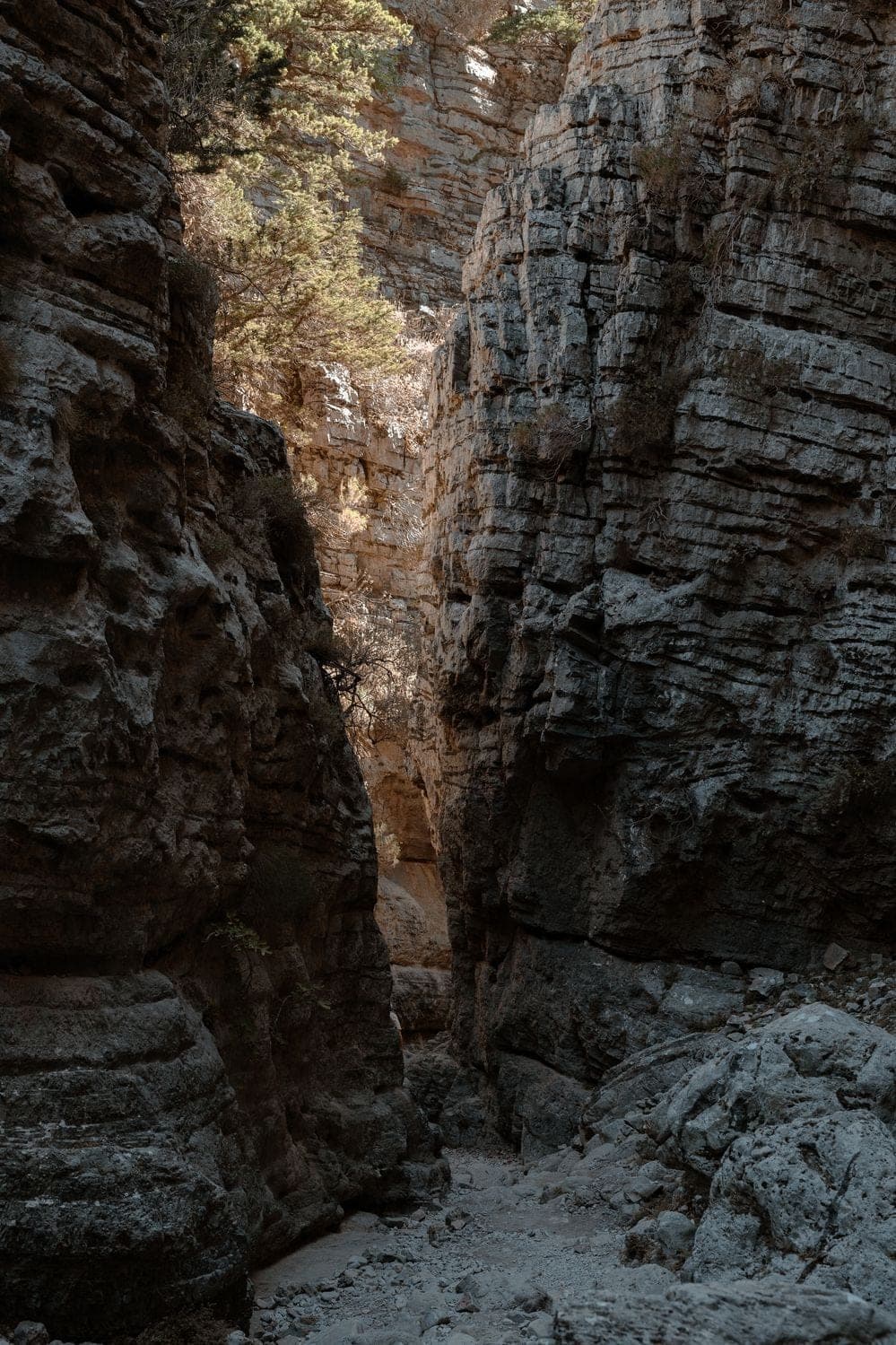
Stenada Imbrou, the narrow passages
The part people come for. The walls squeeze to less than two metres apart in places and go straight up overhead, forming shaded corridors of rock. It is regularly described as a smaller-scale version of the Iron Gates of Samaria, and it holds cool air even in August.
Imbros or Samaria?
Imbros is 8 km against Samaria's 16, takes 2 to 3 hours against 5 to 7, needs no early-morning start and no ferry, and has none of Samaria's fixed May-to-October season. It has no equivalent of Samaria's steep opening staircase, so it is far kinder on the knees. What it does not have is Samaria's scale or its national park status. If you want one Cretan gorge and you are walking with children or without recent hiking practice, Imbros is the one.
History
The gorge has been a route between northern and southern Crete for centuries, and it carries a specific modern memory: in 1941 Allied troops retreating after the Battle of Crete walked down it at night to be evacuated from the south coast at Chora Sfakion.
Getting there
Imbros village is about an hour and a half from Rethymno by road, via Vryses and the climb towards Sfakia. The walk is one way, so a car left at the top has to be collected: guided trips solve this by dropping walkers at Imbros and meeting them at Komitades.
Good to know
How long does it take to walk Imbros Gorge?+
Two to three hours at a relaxed pace for the 8 km. A guided day including hotel pickup, the drive out and the return runs 5 to 7 hours.
Is Imbros Gorge suitable for children?+
Yes. It is the most family-friendly gorge in Crete. The path is 8 km, mostly shaded, and has none of the steep, slippery descents found in Samaria.
Which is better, Imbros or Samaria?+
They answer different questions. Samaria is longer, deeper and more famous, and demands a full 12-hour day with a ferry at the end. Imbros is half the distance, walkable in a morning, open outside Samaria's May to October season and much quieter. Choose Imbros for a first gorge or a family walk, Samaria if the hike itself is the objective.
Which direction should you walk it?+
North to south, starting at Imbros village and finishing at Komitades. That way the entire route is downhill. Walking it uphill from Komitades is possible but considerably harder.
Do you need a guide?+
No. The path is obvious and hard to lose. What a guide adds is the history, the plants and the logistics: the walk is one way, so somebody has to move the car from one end of the gorge to the other.
Visit Imbros Gorge with us
 Hiking
Imbros Gorge
5.0· 60 reviewsThe gentle 8 km gorge walk from the White Mountains down to the Libyan Sea.
- 6h
- small group · max 8
- Most days
From €290
Book this tour Nature
Spring Wildflowers & Orchids of Crete
5.0· 58 reviewsSeven days of orchid plateaus, gorges and mountain flora, based in Spili, for four to six guests
- 7 days
- small group · max 6
- 1 departure
From €1,490
Book this tourRead more about Imbros Gorge
- Rethymno or Chania: Which Should You Base Yourself In?Choose Chania for a short trip built around the most beautiful harbour in Crete and the beaches and gorges of the far west; choose Rethymno for a longer stay, a sandy beach that starts where the old town ends, lower prices, quieter evenings, and a central position that puts both halves of the island within a day's drive. Chania's old town is larger and more spectacular but also far busier and more expensive, and its own town beach is small, so beach days mean driving 40 to 75 kilometres. Rethymno's old town is smaller and more lived-in, with a stronger Ottoman layer, and its beach runs about 12 kilometres east from the harbour. If you have three days, go to Chania. If you have a week and a car, base in Rethymno and drive to Chania for a day.
- Samaria or Imbros? Choosing Between Crete's Two Best-Known GorgesChoose Samaria if you want the landmark and can commit a full twelve-hour day to 16 kilometres of continuous descent from 1,250 metres to the sea, ending at a village reachable only by boat. Choose Imbros if you want the same limestone-corridor scenery in 8 kilometres and 2 to 3 hours of easy downhill walking, with a vehicle waiting at the end, no ferry timetable to catch, and the option of going in any month of the year. Samaria is open only from 1 May to 31 October and is the busiest hiking route in Greece; Imbros runs year-round and carries a fraction of the traffic. For most visitors - families, anyone with knees, anyone who only has half a day - Imbros is the better hike. Samaria is worth it if the length is the point.
- 12 Best Day Trips from RethymnoRethymno is the best day-trip base in Crete because it sits in the middle of the north coast. Within 45 minutes you can reach Lake Kournas and the Argyroupoli springs, the pottery village of Margarites with Arkadi Monastery, and the south coast at Preveli and Triopetra. Within 90 minutes you reach Imbros Gorge and Knossos with the Heraklion Archaeological Museum. Beyond that, at two hours or a little more, lie Aradaina Gorge, the Samaria trailhead at Omalos, the 2,453 m summit of Pachnes, and the pink lagoon at Elafonisi. Every one of the twelve below is a return trip in a single day.
- Best Time to Visit Crete: A Month-by-Month GuideThe best months to visit Crete are May, September and October. May brings 24°C days, an opening Samaria Gorge from 1 May and small crowds; September has the warmest sea of the year at around 25°C with the summer crowds gone; October keeps the sea near 23°C and gives the best walking weather, with Samaria open until 31 October. July and August are the hottest at over 35°C inland, the busiest and the most expensive. April is the greenest month, with wildflowers, over seventy orchid species and Orthodox Easter, but the sea is only about 17°C and Samaria is closed. Winter is mild, cheap and beach-free.