
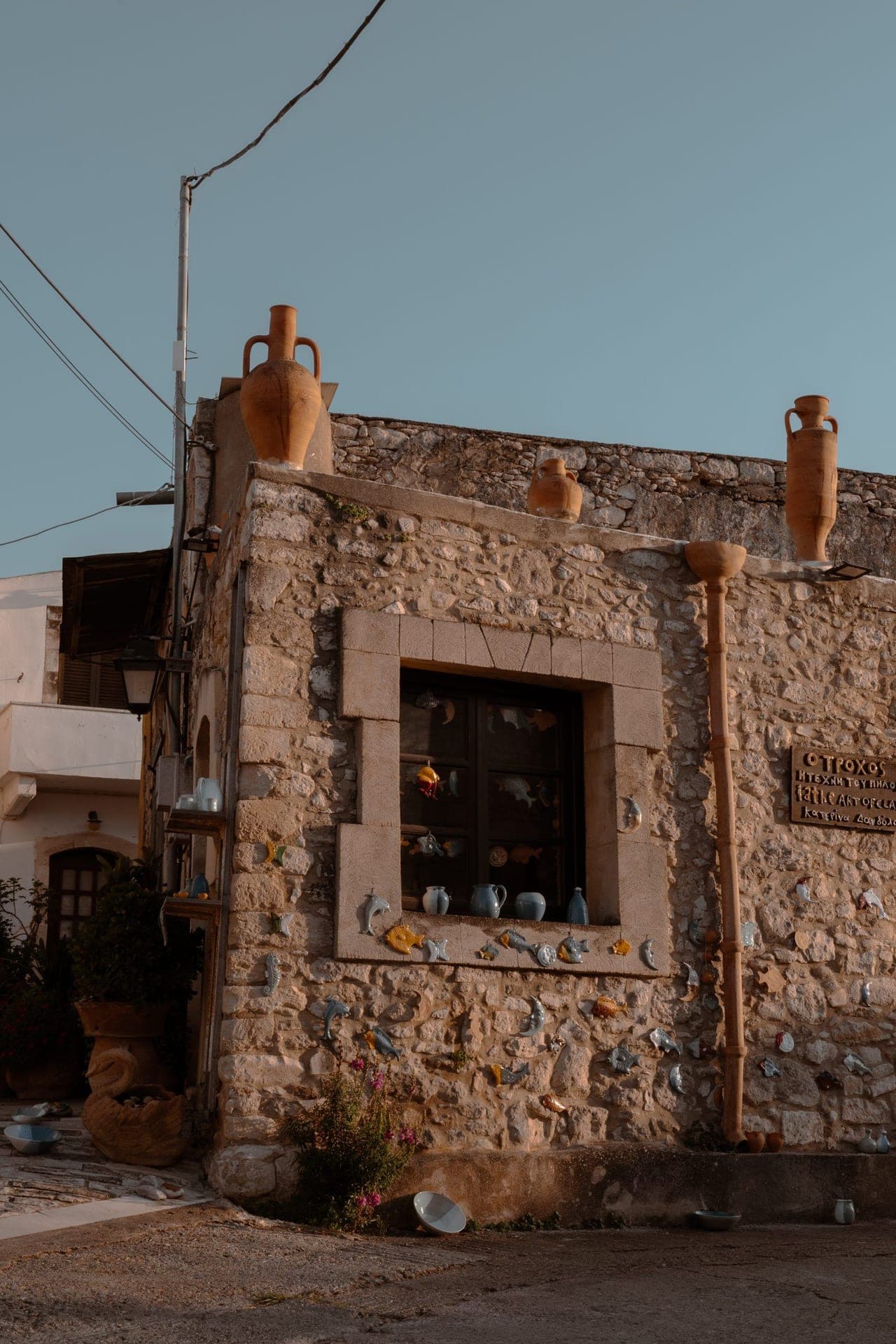
Margarites is a hillside village about 30 minutes south-east of Rethymno that has made pottery for centuries and still does. The draw is not a museum but working workshops: a dozen or so of them along the main street, where potters throw on the wheel in the open and fire kilns on site, and where what you buy comes from the person who made it. The village itself is stone houses, narrow lanes, Byzantine churches and views across the Mylopotamos valley, and it takes about an hour to walk. It is free to visit and pairs naturally with Arkadi Monastery, ancient Eleftherna and the Melidoni Cave, all within the same short circuit.
At a glance
- Cost to visit
- Free
- Drive from Rethymno
- About 30 minutes, roughly 25 km
- Known for
- Ceramics; a dozen or so working pottery workshops along the main street
- Traditional product
- The pithos, the large Cretan storage jar for oil, wine and grain
- Time needed
- About an hour to walk the village and the workshops
- Best time of day
- Morning; most workshops close for a long afternoon break
The pottery
Margarites has clay in the ground around it and has been working it since at least the Venetian period. The local tradition is the pithos, the huge storage jar used for oil, wine and grain, and the biggest ones were built up in stages rather than thrown, then fired in wood kilns for days. That trade collapsed when plastic and steel arrived, and the village survives now on smaller domestic ware, glazed and unglazed, sold to visitors.
What makes it worth the drive is that the workshops are genuinely workshops. Wheels are running, kilns are being loaded, and unfinished pieces are drying on shelves outside. Potters are used to people watching and will usually explain what they are doing.
The village
The main street runs along a shelf on the hillside with the valley dropping away on one side, so almost every cafe terrace has a view. There are Byzantine churches, including Agios Ioannis with fourteenth-century frescoes, and the usual Cretan village fabric of stone houses, external staircases and vines over the lanes. A single square with a couple of tavernas serves as the centre.
Buying
Prices are workshop prices, and pieces vary in quality because they vary in maker. Ask whether something is food-safe and whether the glaze is lead-free if you intend to use it rather than display it, and expect the potter to give you a straight answer.
Practicalities
The village is free to enter and about 25 km from Rethymno, half an hour by car. Park at the entrance and walk in; the main street is narrow. An hour is enough unless you stop to eat. Most workshops close for a long afternoon break, so mornings are the reliable time to see anyone working.
Good to know
What is Margarites known for?+
Pottery. The village has worked the local clay for centuries and still has around a dozen working ceramic workshops, where you can watch potters at the wheel and buy directly from them.
How far is Margarites from Rethymno?+
About 25 km east, roughly 30 minutes by car through the Mylopotamos hills.
Can you watch the potters working?+
Yes, in most workshops, and they are used to it. Mornings are more reliable than afternoons, when many close for a break.
Is there an entrance fee?+
No. Margarites is a village, free to walk into and around. You pay only for what you buy or eat.
What else is nearby?+
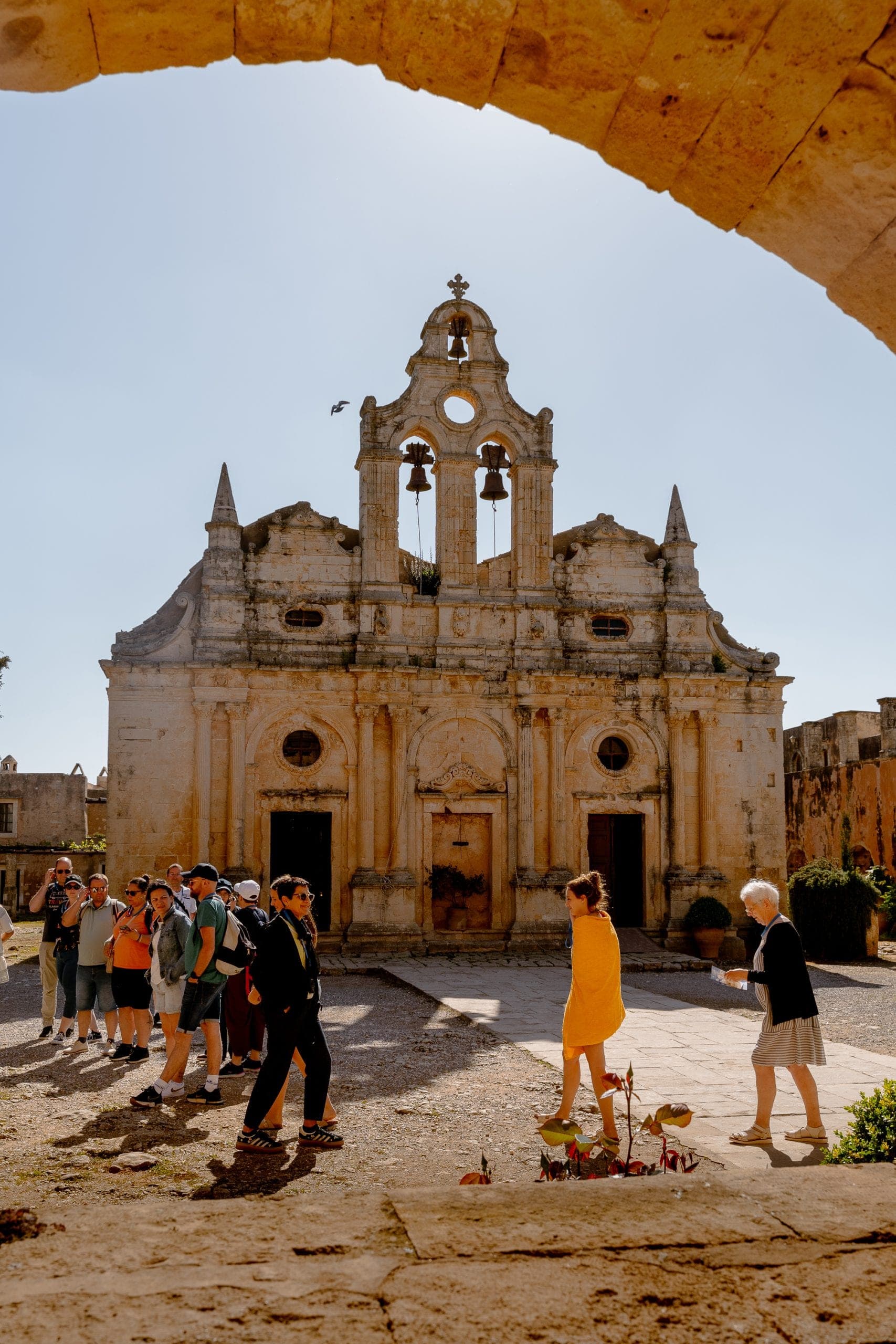
Arkadi Monastery, the archaeological site and museum of ancient Eleftherna, and the Melidoni Cave are all within a short drive, and the four are usually visited as one day.
Visit Margarites with us
Read more about Margarites
- 12 Best Day Trips from RethymnoRethymno is the best day-trip base in Crete because it sits in the middle of the north coast. Within 45 minutes you can reach Lake Kournas and the Argyroupoli springs, the pottery village of Margarites with Arkadi Monastery, and the south coast at Preveli and Triopetra. Within 90 minutes you reach Imbros Gorge and Knossos with the Heraklion Archaeological Museum. Beyond that, at two hours or a little more, lie Aradaina Gorge, the Samaria trailhead at Omalos, the 2,453 m summit of Pachnes, and the pink lagoon at Elafonisi. Every one of the twelve below is a return trip in a single day.
- 20 Beautiful Villages in CreteThe twenty villages worth driving to in Crete run from Maroulas, fifteen minutes from Rethymno with its Venetian tower houses, to Mochlos on the north-east coast two and a half hours away. The essential cluster sits within 45 minutes of Rethymno: Margarites for pottery, Argyroupoli for its springs, Spili for the 25-spout lion fountain, and Anogeia at 740 m for lyra music and shepherd culture. Further afield lie Archanes in the Heraklion wine country, Zaros beneath Psiloritis, Kritsa above Agios Nikolaos for weaving and the Panagia Kera frescoes, the chestnut village of Elos, and Loutro in Sfakia, which has no road in or out at all.
- How Many Days Do You Need in Crete?Seven days is the minimum for a proper Crete holiday and ten is where the island stops feeling like a series of long drives. Three days is a city break confined to one base; five days adds one gorge and one beach day; seven covers western and central Crete from a single hotel, including Samaria or Imbros, Knossos and the south coast; ten lets you split your stay and add Spinalonga, Elounda and the Lasithi plateau; fourteen is a full island loop taking in Vai, Kato Zakros and the roadless south-west villages of Loutro and Agia Roumeli. The island is 260 km end to end, so the constraint is always driving time, not opening hours.
- Things to Do in Crete When It RainsA wet day in Crete is a good day for the parts of the island that have nothing to do with the beach: the caves at Melidoni, Zoniana and Psychro, which are underground and unaffected by weather; monasteries such as Arkadi; the archaeological and folklore museums in Rethymno, Chania and Heraklion; wineries and olive mills, which are working indoor spaces with tastings attached; the pottery workshops at Margarites; and a cooking class, which is the single best use of a wet afternoon. The old towns of Rethymno and Chania also work in rain - the lanes are narrow, roofed cafes are everywhere, and the stone looks better wet. With around 300 sunny days a year, rain is mostly a November-to-March problem, and even then it tends to pass within a few hours.