
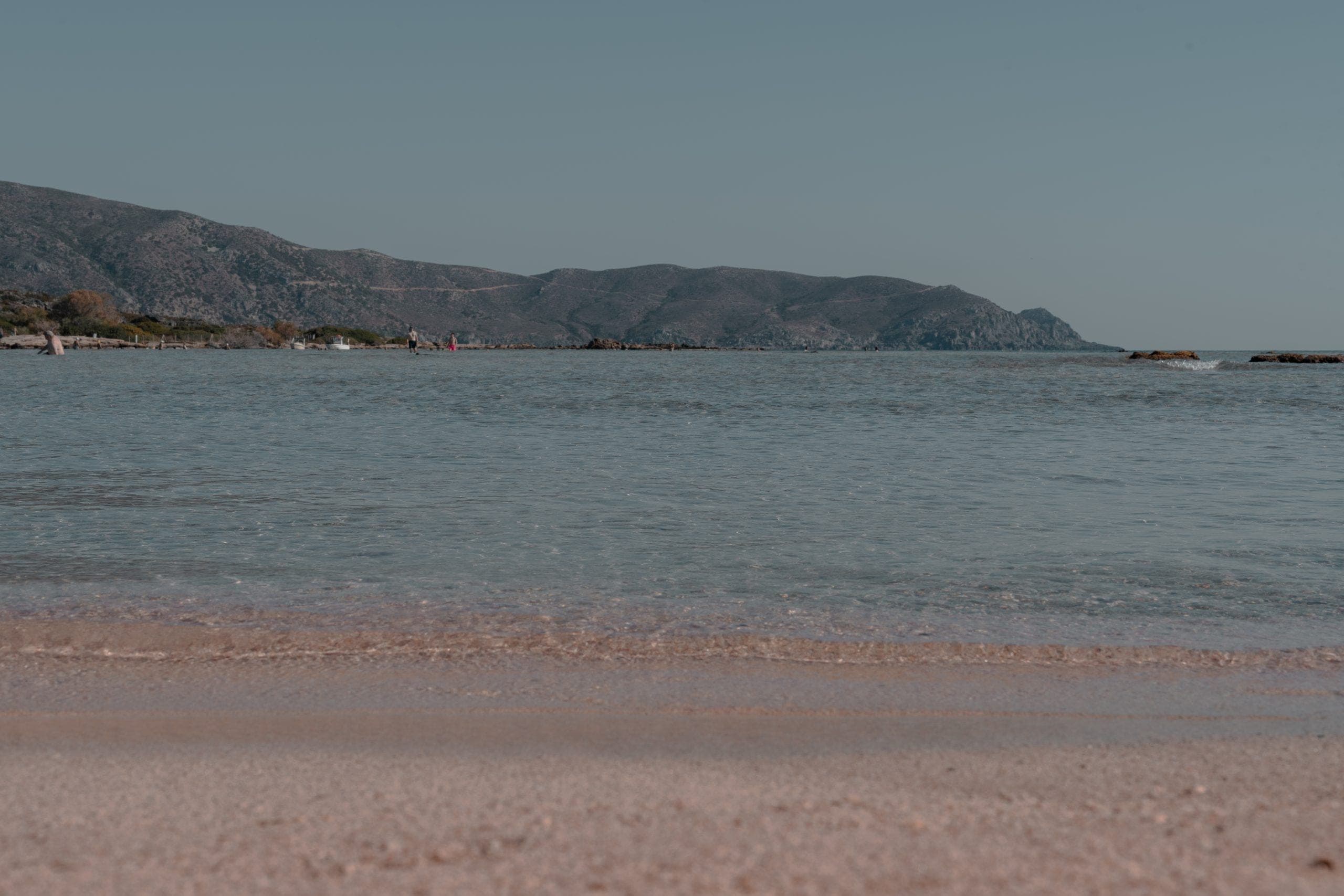
Elafonisi is a pink-sand beach and shallow lagoon at the far south-western tip of Crete, roughly two and a half hours by road from Rethymno. The pink comes from crushed shells of a red-pigmented organism mixed into the white sand, showing as bands along the waterline that vary with tide and light. A lagoon a few tens of centimetres deep separates the mainland beach from Elafonisi islet, a protected nature reserve you can wade to in a couple of minutes; the sand is pinker on the islet and the crowds thin out immediately. Entry is free, parking is charged, and the drive is long enough that this is a full day rather than an afternoon.
At a glance
- Entrance fee
- Free; parking is charged in season
- Drive from Rethymno
- About 2 hours 30 minutes each way
- Crossing to the islet
- Wade across a lagoon usually ankle to knee deep
- Why the sand is pink
- Crushed shells of red foraminifera mixed into white sand
- Protection status
- Natura 2000 nature reserve and loggerhead turtle nesting site
- Open season
- Year-round; sunbeds, canteens and parking staff operate in summer
The pink sand
The colour is real and it is not uniform. Fragments of red foraminifera shells wash up and mix with the white sand, so the pink concentrates where the water has recently been: in strips along the shoreline, in pockets between rocks, and most reliably on the islet side. Bright midday sun washes it out; morning and late afternoon show it best. Taking the sand away is illegal, and the reason the colour has faded in the most trafficked spots.
The lagoon and the islet
Elafonisi islet lies a short distance offshore, separated by water usually ankle to knee deep. Wading across takes a couple of minutes and is the single best thing to do here. The islet is a protected Natura 2000 site with dunes, sea daffodils, juniper and marked paths, quieter beaches on its far side and a memorial to the 1824 massacre of Cretans who had sheltered there. Loggerhead turtles nest on these beaches, which is why the dunes are fenced.
Getting there
There is no short way. From Rethymno the drive is around two and a half hours each way, west across the island and then down through the mountains of south-west Chania, on roads that are narrow and slow for the final stretch. Most itineraries break the journey at Topolia Gorge or the Agia Sophia cave above it. Leaving early matters twice over: for the light on the sand, and for a space in the car park.
Practicalities
Access is free; parking is charged in season. Sunbeds and umbrellas are rented and sell out fast, and there are canteens but no real shade of any kind, so a hat and a towel are worth carrying. Facilities are basic for somewhere this well known. The wind picks up in the afternoon on this coast.
Good to know
Is the sand at Elafonisi really pink?+
Yes, though it is banded rather than uniform. Crushed red shell fragments concentrate along the waterline and in pockets among the rocks, and the colour reads strongest in morning and late-afternoon light.
How long is the drive from Rethymno to Elafonisi?+
About two and a half hours each way. That is why it is a full-day trip: roughly five hours of driving around four or so hours at the beach.
Can you walk to Elafonisi island?+
Yes. The lagoon between the mainland beach and the islet is normally ankle to knee deep and takes a couple of minutes to cross. The sand is pinker on the far side and it is considerably quieter.
Is there an entrance fee?+
No. The beach is free to enter. You pay for parking, and for a sunbed and umbrella if you want them.
When is the best time to visit Elafonisi?+
May, June, September and early October: warm water, softer light on the sand and far fewer people than July and August, when the car park fills by mid-morning.
Visit Elafonisi with us
Read more about Elafonisi
- Rethymno or Chania: Which Should You Base Yourself In?Choose Chania for a short trip built around the most beautiful harbour in Crete and the beaches and gorges of the far west; choose Rethymno for a longer stay, a sandy beach that starts where the old town ends, lower prices, quieter evenings, and a central position that puts both halves of the island within a day's drive. Chania's old town is larger and more spectacular but also far busier and more expensive, and its own town beach is small, so beach days mean driving 40 to 75 kilometres. Rethymno's old town is smaller and more lived-in, with a stronger Ottoman layer, and its beach runs about 12 kilometres east from the harbour. If you have three days, go to Chania. If you have a week and a car, base in Rethymno and drive to Chania for a day.
- Weddings in Crete: Venues, Paperwork and CostsCrete works as a wedding destination because it has two international airports, a season running roughly from April to late October, and genuinely different settings — a Venetian harbour, an olive grove, a mountain village, a beach on the Libyan Sea — within a few hours' drive of each other. Most foreign couples marry in a civil ceremony conducted by a mayor or authorised civil official, which is a real legal marriage recognised internationally; the work is in the paperwork, which means passports, birth certificates, a Certificate of No Impediment for each party, Apostille legalisation and official Greek translation, submitted to the municipality where you are marrying. Municipal ceremony fees are commonly quoted at roughly €100 to €550, everything else is quote-driven, and the single thing that catches wedding parties out is scale: Crete is about 260 km end to end, guests arrive at two different airports across two or three days, and transport needs planning long before the final numbers are in.
- 12 Best Day Trips from RethymnoRethymno is the best day-trip base in Crete because it sits in the middle of the north coast. Within 45 minutes you can reach Lake Kournas and the Argyroupoli springs, the pottery village of Margarites with Arkadi Monastery, and the south coast at Preveli and Triopetra. Within 90 minutes you reach Imbros Gorge and Knossos with the Heraklion Archaeological Museum. Beyond that, at two hours or a little more, lie Aradaina Gorge, the Samaria trailhead at Omalos, the 2,453 m summit of Pachnes, and the pink lagoon at Elafonisi. Every one of the twelve below is a return trip in a single day.
- 15 Best Family Beaches in CreteThe best family beaches in Crete combine a sheltered bay with a long shallow shelf, real shade, parking close to the sand and a taverna within walking distance. Elafonisi's knee-deep pink lagoon and the wide flats at Frangokastello are the safest for toddlers; Georgioupolis, Almyrida, Bali and Agia Pelagia are the most reliable all-rounders; Falassarna, Matala, Malia and Vai suit older children; and Balos, though spectacular, is an expedition rather than a beach day. The single most useful rule is to move to the south coast — Damnoni, Plakias, Preveli, Frangokastello — whenever the meltemi is blowing from the north in July and August.