
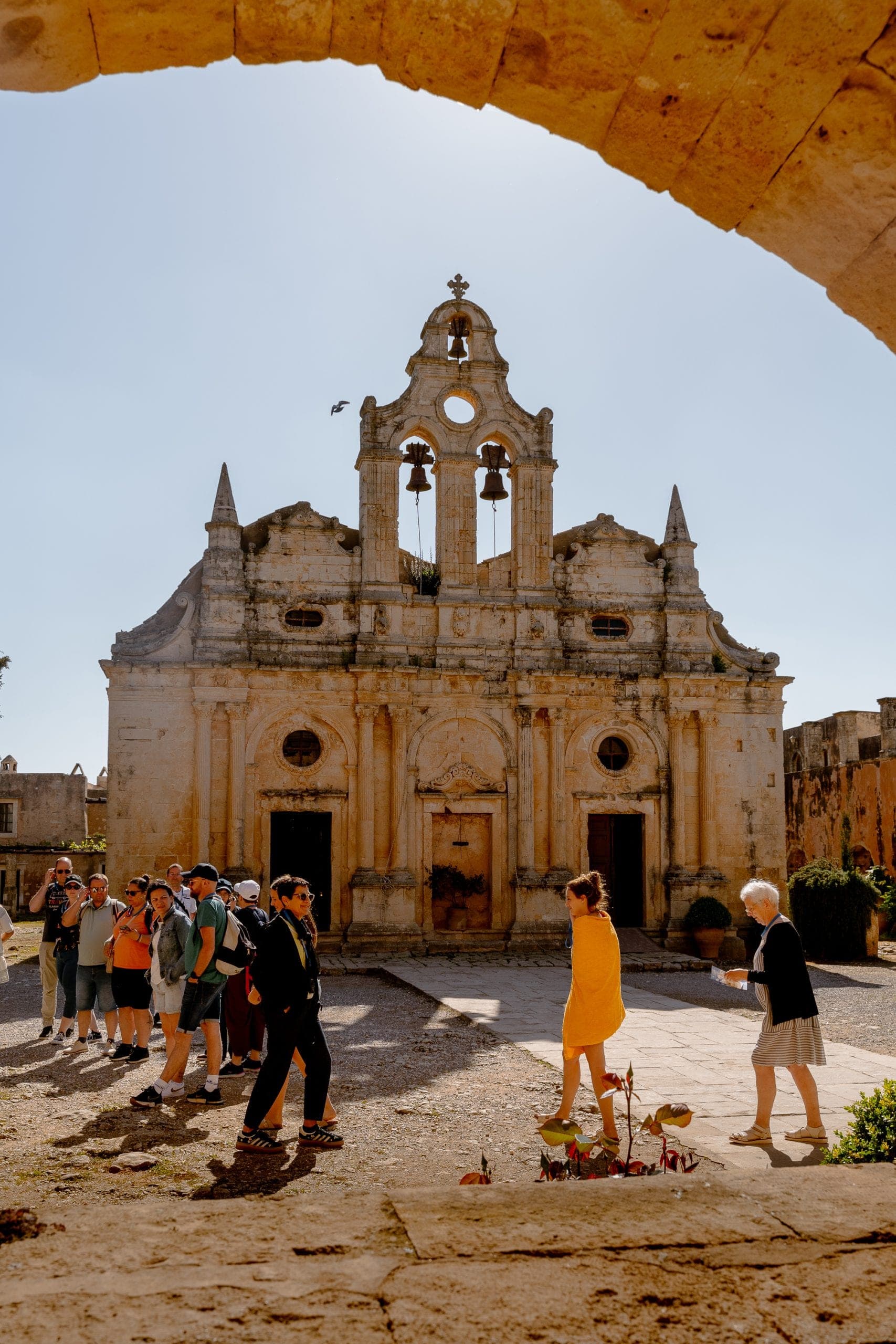
Arkadi Monastery stands at about 500 metres in the hills roughly 30 minutes south-east of Rethymno, and is the single most politically charged building in Crete. Its 16th-century Venetian-Baroque church facade is the image on the old 100-drachma note, but the reason Cretans come is November 1866: hundreds of Cretan fighters and their families, besieged inside by Ottoman troops, blew up the powder magazine rather than surrender. The event turned Arkadi into an international cause and the monastery into the emblem of the Cretan struggle for union with Greece. There is a small museum of documents, weapons and relics, and an ossuary in the former windmill outside the walls.
At a glance
- Drive from Rethymno
- About 30 minutes, roughly 23 km
- Altitude
- About 500 m
- Church built
- 1587, with a Venetian Baroque facade
- Key date
- 8 November 1866, when the powder magazine was detonated during the Ottoman siege
- Entrance fee
- Charged at the gate and paid on the day; the amount is not published on the tour pages
- Dress code
- Shoulders and knees covered; it is a working monastery
Why Arkadi matters
On 8 November 1866, with an Ottoman force of many thousands outside the walls, several hundred Cretans sheltering in the monastery detonated the gunpowder store beneath them. Almost everyone inside died, along with a large number of the attacking troops. News of it reached Europe within weeks and made Cretan autonomy a diplomatic question rather than a local insurgency. The date is a Cretan national anniversary, and the monastery's abbot and the fighters are commemorated as martyrs.
What you see
The church, built in 1587, has a two-aisled facade of Corinthian columns, a triple bell tower and a pediment, closer to a Venetian church front than to a Byzantine one, which is exactly what it is. The courtyard around it is walled, with monks' cells, a refectory that still shows sabre marks, storerooms and the roofless powder magazine where the explosion happened, left as it was.
The museum holds the 1866 material: the standard, weapons, vestments, icons and documents. Outside the entrance, the old windmill houses an ossuary containing the skulls of those killed.
Setting
The monastery sits in olive groves and vineyards on a plateau, and the drive up from the coast is part of the visit. It is roughly 23 kilometres from Rethymno on a good road, half an hour door to door, and combines naturally with Eleftherna, Margarites and the Melidoni Cave in the same stretch of hill country.
Practicalities
Arkadi is a working monastery and an entrance fee is charged at the gate; the operator does not publish the amount and it is paid on the day. Shoulders and knees should be covered. An hour is enough for the church, the courtyard, the museum and the ossuary.
Good to know
What happened at Arkadi Monastery in 1866?+
During the Cretan revolt against Ottoman rule, several hundred fighters and their families took refuge inside. Besieged and about to be overrun on 8 November 1866, they blew up the monastery's powder magazine, killing themselves and many of the attackers. The act made Cretan independence an international issue.
How far is Arkadi Monastery from Rethymno?+
About 23 km, roughly 30 minutes by car on a good road through the hills.
Is there an entrance fee?+
Yes, an admission charge is collected at the gate and paid on the day. It is not included in tour prices and the amount is not published on the tour pages.
How long do you need at Arkadi?+
About an hour covers the church, the courtyard, the refectory, the powder magazine, the museum and the ossuary in the windmill outside the walls.
Is there a dress code?+
Yes. It is an active monastery, so shoulders and knees should be covered for both men and women.
Visit Arkadi Monastery with us
Read more about Arkadi Monastery
- Is Rethymno Worth Visiting?Yes. Rethymno is worth visiting, and the specific reason is that it is the only city in Crete that gives you three things at once: an intact Venetian and Ottoman old town you can walk end to end in fifteen minutes, a long sandy beach that starts where the old harbour ends, and a position halfway along the island that puts Knossos, Samaria, Elafonisi, Spinalonga, Preveli and the White Mountains all within a day's drive of the same hotel. It is smaller and quieter than Chania, cheaper than either Chania or Heraklion, and - because the University of Crete's humanities campus is here - it stays a working city out of season rather than closing down. The case against it is that it has no airport, its beachfront hotel strip is generic, and its old town is noisy in August.
- 12 Best Day Trips from RethymnoRethymno is the best day-trip base in Crete because it sits in the middle of the north coast. Within 45 minutes you can reach Lake Kournas and the Argyroupoli springs, the pottery village of Margarites with Arkadi Monastery, and the south coast at Preveli and Triopetra. Within 90 minutes you reach Imbros Gorge and Knossos with the Heraklion Archaeological Museum. Beyond that, at two hours or a little more, lie Aradaina Gorge, the Samaria trailhead at Omalos, the 2,453 m summit of Pachnes, and the pink lagoon at Elafonisi. Every one of the twelve below is a return trip in a single day.
- 20 Beautiful Villages in CreteThe twenty villages worth driving to in Crete run from Maroulas, fifteen minutes from Rethymno with its Venetian tower houses, to Mochlos on the north-east coast two and a half hours away. The essential cluster sits within 45 minutes of Rethymno: Margarites for pottery, Argyroupoli for its springs, Spili for the 25-spout lion fountain, and Anogeia at 740 m for lyra music and shepherd culture. Further afield lie Archanes in the Heraklion wine country, Zaros beneath Psiloritis, Kritsa above Agios Nikolaos for weaving and the Panagia Kera frescoes, the chestnut village of Elos, and Loutro in Sfakia, which has no road in or out at all.
- How Many Days Do You Need in Crete?Seven days is the minimum for a proper Crete holiday and ten is where the island stops feeling like a series of long drives. Three days is a city break confined to one base; five days adds one gorge and one beach day; seven covers western and central Crete from a single hotel, including Samaria or Imbros, Knossos and the south coast; ten lets you split your stay and add Spinalonga, Elounda and the Lasithi plateau; fourteen is a full island loop taking in Vai, Kato Zakros and the roadless south-west villages of Loutro and Agia Roumeli. The island is 260 km end to end, so the constraint is always driving time, not opening hours.